




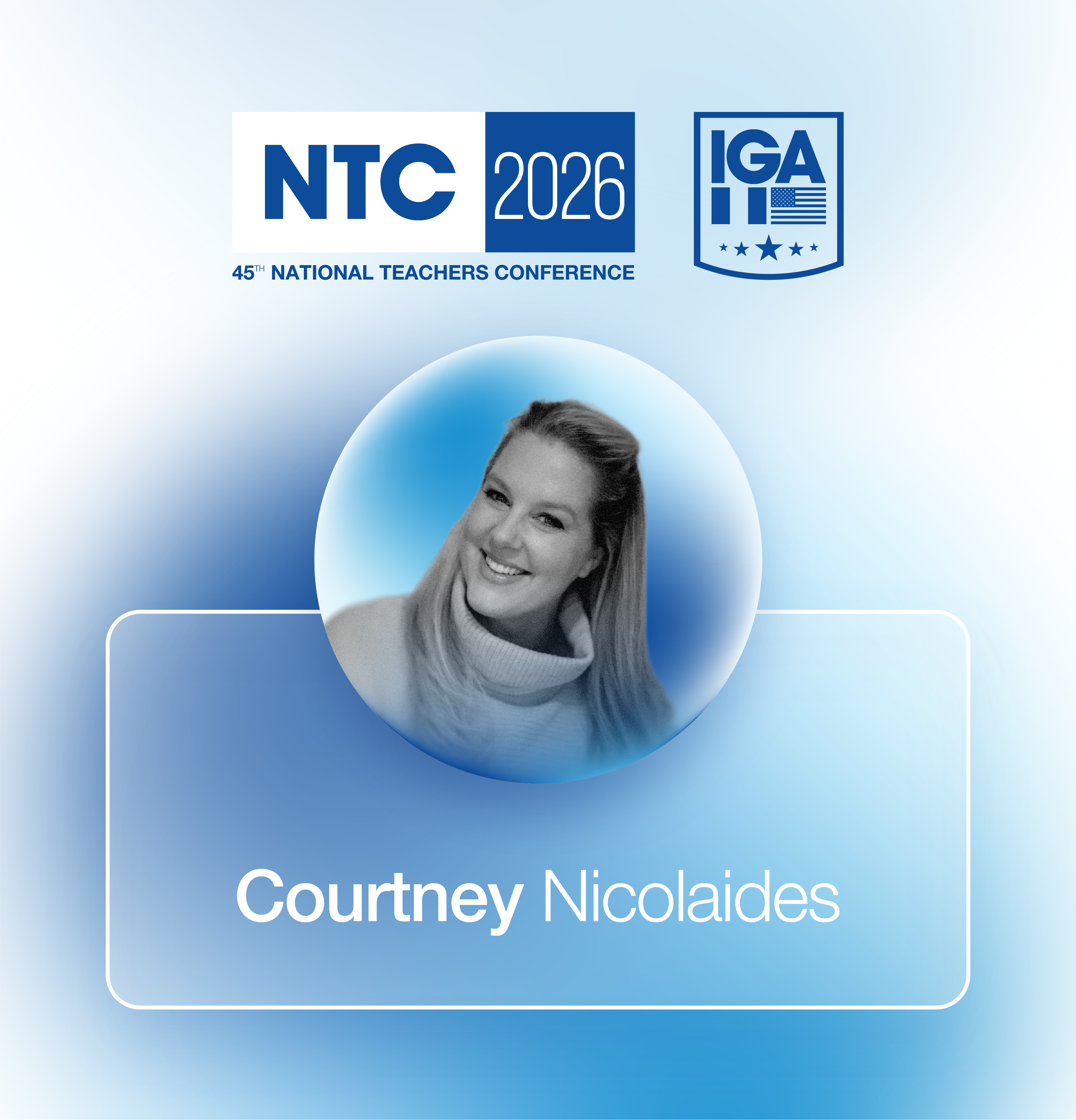
Event: IGA NTC 2026
Courtney is an international speaker and educator. Her career spans teaching, training and school leadership, the design of curricula, textbooks, and assessment systems around the world. She holds a bachelor’s degree from the University of California and a master’s degree from Masaryk University, Czech Republic, and credentials in education policy and leadership from FLACSO and CIDE in Mexico and the Harvard Graduate School of Education. She works in EdTech, helping university instructors across Canada and the United States integrate Artificial Intelligence into their teaching. She is founder and director of Colossal Kids, a Reggio Emilia–inspired nursery and preschool that blends creativity, exploration, and future-ready learning.
What Should Still Matter in Teaching and Learning in the Age of AI?
We are asked to redesign teaching and learning in response to AI, in a context shaped by contradictory narratives, difficult-to-interpret evidence, and rapidly evolving technology.
Some view AI as a solution for personalization, timely feedback, differentiation, and accessibility. Others emphasize its risks: misinformation, superficial understanding, and a weakening of students’ capacity to think independently.. In this context, educators and decision makers are not simply deciding whether to use AI, but how to make informed curricular, pedagogical, and institutional choices.
This plenary begins by mapping some of the competing narratives surrounding AI in education and offering participants reliable sources to enrich informed perspectives. Then we ask: how might the communicative skills we prioritize need to be reconsidered?
The plenary will consider the kinds of competencies that deserve renewed attention, across the curriculum and within English teaching. Drawing on broader educational discussions as well as the principles of communicative language teaching, it will suggest that students need more than technical familiarity with new tools. They increasingly need to interpret information carefully, question, evaluate ideas and sources with greater discernment, make reasoned decisions, and communicate purposefully. In the language classroom, this matters in particularly clear ways, since learning a language involves not only producing correct forms, but making meaning, responding to context, and engaging with others in ways that are purposeful, flexible, and real.
We offer a framework for deciding what continues to work in teaching and learning and what may need to be done differently. Rather than assuming that everything must change or that nothing should, the session will focus on a more careful question: which practices still help learners build understanding, judgment, communication, and real-world application, and which ones may need to be redesigned because they reward speed, routine production, or surface completion more than meaningful learning? In the English language classroom, this means looking closely at whether tasks invite learners to interpret information, exchange ideas, justify decisions, negotiate meaning, and communicate for authentic purposes. AI may at times support this work through rehearsal, feedback, comparison, or critique, but it should not replace the thinking and interaction through which learning develops.
AI and Teaching Speaking
Artificial Intelligence is increasingly entering language classrooms, with the promise of reducing teachers’ administrative workload while improving the student experience through more personalized, efficient, and engaging activities. However, it is incumbent upon school leaders to analyze the actual impact of Large Language Model use on both individual and group learning outcomes and support teachers' understandings of how Large Language Models can support or hinder the development of writing, reading, listening, and speaking skills. This session explores criteria for deciding when and how AI can meaningfully enhance skills development in the English language classroom, with particular attention to speaking. On one hand, AI can expand opportunities for rehearsal, generate differentiated prompts, support vocabulary retrieval and encourage participation among hesitant learners.
On the other hand, it can reduce authentic interaction, foster overdependence on generated language, and weaken learners’ ability to negotiate meaning spontaneously.
Grounded in communicative and learner-centered principles, this session argues that the central issue is not whether AI should be used, but how speaking tasks are designed around it. Participants will examine a practical framework for evaluating AI-mediated speaking activities through three guiding questions: Does the task increase learner agency? Does it preserve authentic interaction? Does it strengthen communicative competence?
Through examples of classroom tasks, participants will analyze when AI functions as a scaffold, simulator, feedback partner, or obstacle. The session will conclude with concrete design principles teachers can use to ensure that AI supports rather than replaces meaningful oral communication. This presentation is especially relevant for educators seeking practical and reflective ways to respond to the future of education while keeping the students, ethics and critical thinking at the center of the teaching and learning process.
AI and Teaching Speaking
11/03/2026
11:00 a.m. – 12:00 p.m.
15:15 – 16:30 p.m.